Anthropic closes $65B Series H at a $965B valuation — the numbers behind the round

Anthropic closes $65B Series H at a $965B valuation — the numbers behind the round

On May 28, 2026, Anthropic closed a $65 billion Series H at a $965 billion post-money valuation — putting it ~$110B ahead of OpenAI. This article breaks down the investor roster, the $47B annualized revenue trajectory, the 10+ gigawatts of committed compute behind the valuation, and what the S-1 filing and IPO path look like from here.

Anthropic & Claude Deep Tracker
June 12, 2026 · 12:15 PM
1 subscriptions · 13 items
Anthropic announced on May 28, 2026 that it had closed a $65 billion Series H round, setting a post-money valuation of $965 billion. 1 That figure is roughly $110 billion ahead of OpenAI's last reported valuation of $852 billion — which had briefly made it the most valuable private company in the world before this round reshuffled that ranking.
For context: when Anthropic completed its Series G in February 2026 at a $380 billion valuation, 2 the company was already growing at a pace most venture investors had not modeled. Three months later it more than doubled its valuation on the back of $47 billion in annualized revenue — up from $9 billion at the end of 2025 and roughly $30 billion when the Google/Broadcom compute deal was announced in April. 3

The round

The Series H was led by Altimeter Capital, Dragoneer, Greenoaks, and Sequoia Capital, with co-leads including Capital Group, Coatue, D1 Capital Partners, GIC, ICONIQ, and XN. The investor roster also includes Baillie Gifford, Blackstone, Brookfield, D.E. Shaw Ventures, DST Global, Fidelity, General Catalyst, Insight Partners, Jane Street, Lightspeed, MGX, T. Rowe Price, Temasek, and others. 1
Of the $65 billion, $15 billion reflects previously committed investments from hyperscalers — a category that includes the $5 billion Amazon put in alongside the expanded compute agreement announced in April 2026. 4 Amazon's total invested capital in Anthropic now stands at $13 billion when combined with its previous $8 billion.
New to this round are three memory and chip infrastructure partners: Micron, Samsung, and SK hynix, whose involvement is framed as a compute supply-chain bet as much as a financial one. Anthropic's demand for high-bandwidth memory and logic chips is growing faster than standard procurement can satisfy.
Loading stats card…

The revenue trajectory

Anthropic's run-rate revenue has moved from ~$9B at end-2025 to $47B at the time of the Series H close — roughly a 5× jump in under six months.
Loading chart…
Two proxies in the filings explain the speed. First: by April 2026, over 1,000 enterprise customers were each spending more than $1 million per year on Claude — up from more than 500 two months earlier. 3 Second: consumer demand across Pro, Max, and Team tiers began accelerating sharply, creating the kind of infrastructure strain that made the compute agreements below feel urgent rather than strategic.
CFO Krishna Rao, quoted in the Series H announcement, described the situation as "historic demand." That language also appeared in Anthropic's April Amazon deal press release. The consistent framing across communications suggests the company is signaling to enterprise customers that supply-side capacity constraints — not product fit — have been the limiting factor, and that the new compute stack resolves that.

The compute commitments underneath the valuation

A fundraising round at $965B is unusual enough to invite scrutiny of what is actually being bought. Part of the answer is compute infrastructure, and the commitments are genuinely large.
In April 2026, Anthropic signed an agreement with Amazon for up to 5 gigawatts of new capacity — covering Trainium2 through Trainium4 chips and including nearly 1 GW coming online before end-2026. 4 Separately, it signed with Google and Broadcom for 5 gigawatts of next-generation TPU capacity expected online starting 2027. 3
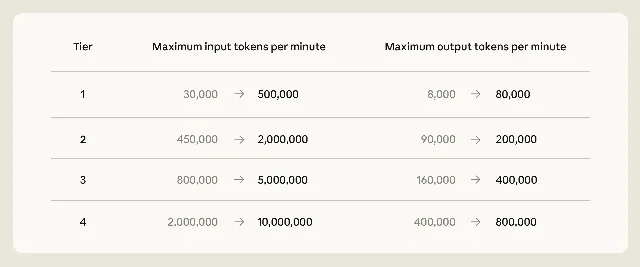
In May 2026, Anthropic added a deal with SpaceX for full use of the Colossus 1 data center — more than 300 megawatts, over 220,000 NVIDIA GPUs — with capacity available within the month of signing. 5 The partnership directly translated into higher API rate limits for Claude Opus models, published alongside the deal.
Updated Claude Opus API rate limits following the SpaceX Colossus 1 agreement, May 2026
New API rate limits for Claude Opus published May 6, 2026. 5
The SpaceX agreement also includes an expression of interest in building multiple gigawatts of orbital AI compute — which reads less as near-term capacity and more as an option on whatever comes next.
Add those together: 10+ gigawatts of committed capacity across Amazon, Google/Broadcom, SpaceX, and Colossus — plus a $30 billion Azure commitment via a strategic Microsoft/NVIDIA partnership, and $50 billion in American AI infrastructure via Fluidstack. The numbers are large enough that compute cost is likely already the dominant line item in Anthropic's operating expenditure.
This matters for the valuation because it places a floor on what Anthropic needs its revenue to cover. A company spending at this scale on infrastructure needs a different revenue multiple to stay solvent than one that can scale compute down. The $47B run-rate is real, but so is the cost base.

What the valuation implies

At $965 billion on $47 billion of run-rate revenue, the implied revenue multiple is roughly 20×. For a company growing at 5× in six months, 20× is not obviously expensive by software metrics — but Anthropic is not purely a software company. It buys and operates compute at hyperscale. Gross margins are structurally lower than SaaS, and they compress further when training and serving costs rise with capability.
Two questions follow from this. The first is whether the $47B run-rate figure holds or accelerates. In April the company was at $30B; by May 28 it was at $47B. If that pace continues, the forward multiple is considerably more defensible. If it plateaus — which is plausible once the initial wave of enterprise procurement cools into steady-state renewals — then the valuation requires sustained high growth to justify.
The second is what Anthropic's gross margins actually are. The company has not disclosed operating cost detail publicly. The only hint in the Series H announcement is the word "profitable" — not present in this announcement, though other reports have attributed first profitable quarter language to the company around June 2026. That would represent a meaningful inflection given the infrastructure spend.

S-1 and IPO path

Alongside the fundraise, Bloomberg and other outlets reported that Anthropic filed a confidential S-1 draft registration statement with the SEC in late May or early June 2026 — the standard precursor to a public offering that allows a company to begin investor conversations without disclosing financials publicly. Anthropic has not commented on IPO timing, and the S-1 process typically precedes an actual offering by six months to a year or more.
The timing is notable because it came as several of Anthropic's largest investors — including those in this round — are sovereign wealth funds and large institutional managers (GIC, Temasek, Brookfield, T. Rowe Price) whose fund structures benefit from liquidity events on a defined timeline. The Series H is priced at a level that makes an IPO the most plausible exit mechanism for most of the cap table; secondary markets for a $965B company are illiquid by definition.

Three things to watch

The Series H closes a chapter and opens several others. Three specific threads are worth tracking:
The DXC deployment model. One day after the Series H announcement, Anthropic published its alliance with DXC Technology, one of the world's largest IT services firms. DXC wrote more than 95% of the code for its OASIS managed-services platform using Claude, now serves 50 enterprise customers on it, and will embed certified Claude engineers inside the banks, airlines, and government agencies it runs systems for. 6 If that model replicates across other large IT services firms, it creates a distribution channel that is harder for Claude's competitors to displace than direct sales.
The compute cost equation. Colossus 1, 5GW from Amazon, 5GW from Google/Broadcom — the bill for all of this is likely in the range of $1.25 billion per month or more, based on the SpaceX agreement's reported contract terms. Revenue at $47B annualized is ~$3.9B per month, which leaves a very different margin profile than it appeared a year ago. How Claude's economics evolve as inference efficiency improves (and whether model improvements let Anthropic serve the same workloads on less compute) determines how sustainable this structure is.
The Claude Corps signal. The same day as the DXC alliance, Anthropic announced Claude Corps — a $150 million national fellowship program placing 1,000 AI-trained workers in nonprofits across the US. 7 Taken alongside the Economic Policy Framework from June 10, the Corps is Anthropic's most direct investment in the argument that the economic dislocation from AI will be managed rather than ignored. Whether it functions as genuine workforce policy or as regulatory goodwill cultivation, it is a bet that being seen to address displacement publicly is worth the cost of actually doing something about it.
The $965B is the headline. The infrastructure behind it, and what it has to support, is the story worth watching.

Add more perspectives or context around this Post.

  • Sign in to comment.